
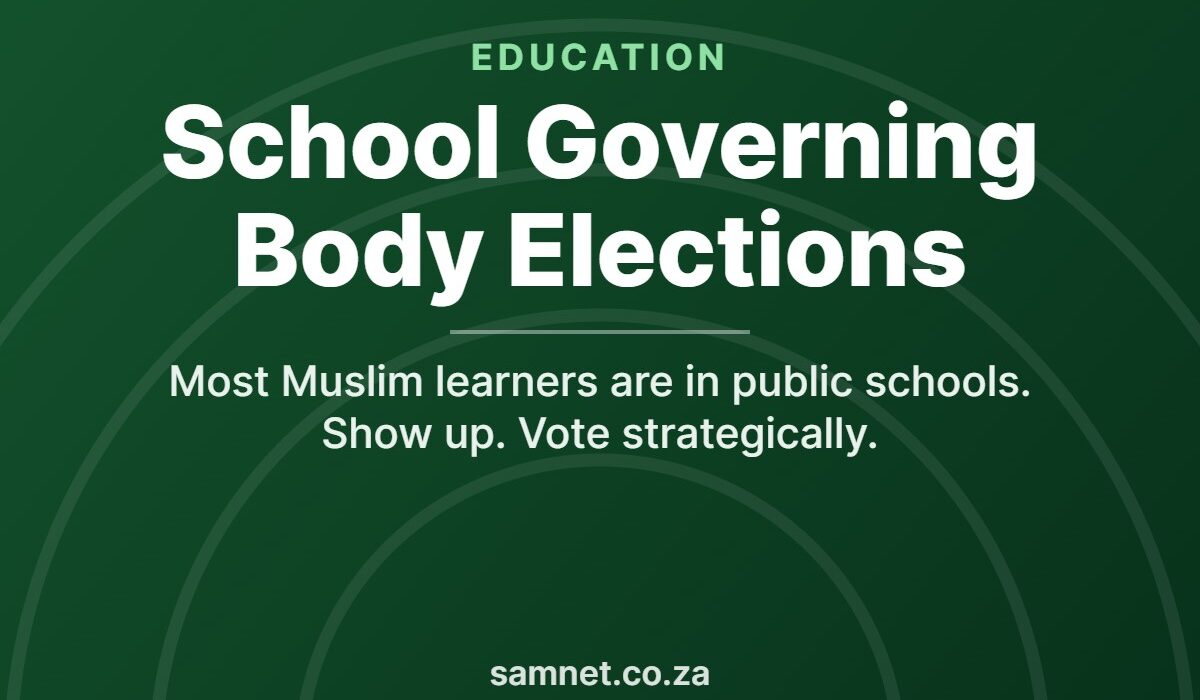
School Governing Body elections run at public schools across South Africa from 1 March to 30 April 2024. SAMNET calls on the Muslim community to take part.
While we express our concerns about BELA legislation, we must not fail to use the opportunities the SGB already offers. If we care about how our children are educated, and about the move for government to take more control of that education, we need to act now.
Background
These elections are legislated to be held every three years at tens of thousands of public schools. SGBs are critical to the smooth functioning of a school.
It is the view of community and education experts that positively influencing school education in South Africa directly benefits all our children’s futures, and the country’s. Many of the service delivery and social problems we face today are a direct result of poor education in the past.
What an SGB Actually Controls
- Financial and operational governance of the school
- Appointment of principals, teachers and administrators, and disciplinary procedures
- Setting of fees and oversight of spending
- Policies for education, uniforms and events
- The ethos, values and discipline of the school
- How the curriculum is interpreted and applied
An SGB can also influence, for better or worse, access for particular groups of students, the demographic profile of the school, and the quality of education it provides.
How the Vote Works — and How to Use It
- Nominations close early. Candidates must be nominated and must accept the nomination under the school’s rules, sometimes two days beforehand.
- There are usually two evenings. The first requires a quorum; if it is not met, a second date is set where no quorum is needed. Parents should make themselves available for both.
- A small turnout improves the chances of minority candidates.
- Each parent has one vote, so one child in a school carries two votes. Both parents should attend to use them.
- Bring your ID and register at the election.
- Vote strategically. Votes are cumulative: vote only for the candidate or candidates you are actually supporting. Spare votes may count against your candidate.
- Be an observer. Votes are counted in the presence of observers.
- An SGB may co-opt additional unelected members, but is not obliged to.
Choosing Candidates
Most Muslim learners in South Africa are not in private, Islamic or majority-Muslim schools. In most cases they are a minority, often in less affluent communities. That is the context for participation and representation.
- A diplomatic, common-sense person who can work with a diverse team adds real value.
- SGBs and other parents look for useful skills — finance, law, education, human resources, building maintenance, fundraising.
- Candidates need the time to attend meetings, subcommittees and projects.
- Good candidates who are not Muslim should be fairly supported where they hold the values and understand the needs of the community.
We caution against anyone who would treat this as an “Islamisation” of education. Efforts of that kind take away from the efficient, non-racial, multi-religious and inclusive nature of public education.
What Educators and Serving SGB Members Told Us
- An elected member cannot enforce a view, but can influence and can lodge objections from inside the SGB. Participation has to be seen across years, even generations.
- The impact is gradual, but it can last decades if it is sustained.
- Parents often treat getting a child into a former Model C school as the end point. It is the start.
- Some parents make unreasonable demands of a school, discouraging diversity and portraying Muslims as difficult.
- Members who are elected can be frustrated by being marginalised.
Ramadan or Not, We Need to Be There
The second voting evening may fall within Ramadan. We should see that as an obligation to attend rather than a reason not to. If necessary, take your iftaar and your musallah.
Most parents take leave to attend school functions or sport. SGB elections are as important, if not more so. Previous generations were involved in building and running schools under far more adverse and oppressive conditions than these.
Why This Matters for Incidents at Schools
Over the past few years SAMNET has assisted with a number of incidents involving learners, parents and teachers where a school has been uncompromising or even hostile. Many of these involved SGBs or principals. In most cases a visible, engaged parent body would have helped. Where parents are not involved before a problem arises, mediation afterwards is much harder.
There are also many cases where Muslims have built standing on SGBs, or through relationships, by contributing — and where schools have then been able to accommodate Muslim and other communities reasonably.
What SAMNET Is Offering
- A poster and flyer for circulation at masaajid and elsewhere.
- Speakers and advice — educators and serving or former SGB chairpersons and members are available for interviews, teleconferences and meetings. Arrangements through our office.
- A channel for feedback and ideas to share across the network.
To give your time and skills for the upliftment of others, and especially of our children, is a form of serving mankind.
Shared by the South African Muslim Network (SAMNET) in the interest of promoting social involvement and education for all South Africans.
Contact SAMNET
info@samnet.co.za
WhatsApp 084 333 3979
www.samnet.co.za
1 Comment-
Pingback: Why the SGB Elections Matter — and Who You Elect - SAMNET