
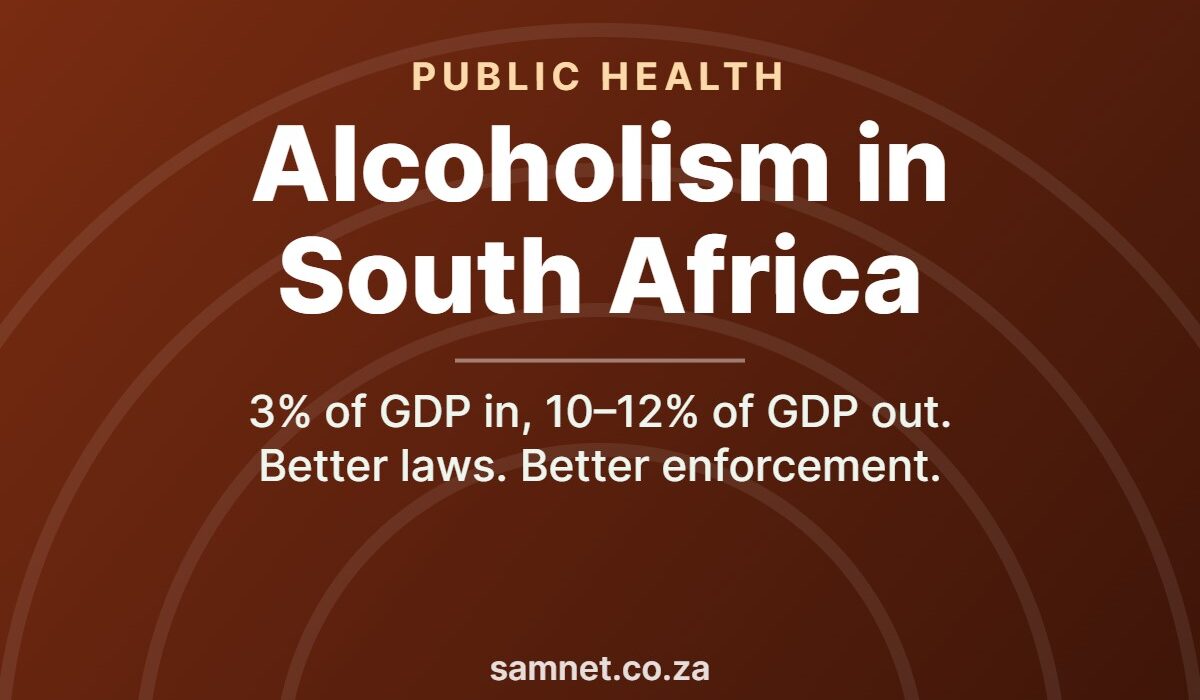
We need more discussion, debate, better laws and more enforcement.
South Africa was among the first countries to block the sale of alcohol during COVID-19. The impact was immediately palpable, with reductions in accidents, hospital admissions, gender-based violence and crime. If anything, that should have been a key driver — real-world evidence and learning for greater controls on alcohol advertising and access after the pandemic.
Civil society has a mountain to climb against the alcohol lobby and the related industries that make money off its intoxicating influence — directly in the case of gambling, and indirectly through professional sport, nightclubs and other entertainment.
The critical issues in South Africa are youth, addiction and binge drinking — and, as the article below shows, they are not limited by gender, affluence, education or personal circumstances.
People make bad choices while under the influence of alcohol.
Our society bears the consequences of those bad choices.
We all pay a price for those bad choices.
The Enyobeni tragedy, murders, crime, vehicle accidents, pedestrian deaths, abuse, rape, sexual assault, violence in the home, workplace accidents and lost productivity have all been shown by research to have a substantial causal link to alcohol — yet we do not seem to be demanding that our legislators and law enforcement try something different.
What to Look Into
- How the draft Liquor Amendment Bill has been stonewalled and bundled into obscurity since 2016, and how lobbying waters down legitimate protections.
- How the Basic Education Laws Amendment (BELA) Bill affects the rule banning alcohol in schools.
- How university administrators face the consequences of binge drinking, gender-based violence and property damage linked to alcohol.
The Cost, in DG Murray Trust’s Own Words
Even though less than a third of South Africans consume alcohol, we are a nation of heavy drinkers. This is because more than half of those who drink are ‘binge drinkers’, defined as having more than five standard drinks in one sitting. The South African liquor industry contributes an estimated R68 billion annually to the fiscus – around 3% of the total GDP. But the harmful effects of heavy drinking cost the country much more in both direct and indirect costs. Research conducted in 2014 illustrates a R277 billion yearly cost through the combined impact of health and welfare expenses and indirect costs, such as productivity losses from absenteeism. Adjusted for inflation, this equates to an annual cost of R433 billion to the South African economy in 2023. In other words, the industry contributes 3% to GDP yet the loss to GDP is 10–12%.
Extract from the DG Murray Trust Alcohol Harms Reduction Campaign
For a Better Society, Create Better Norms
We cannot transform our country and take people out of poverty while enabling all the root causes that keep them there.
Sinalo Jafta’s Account
The Sinalo Jafta interview is a rare discussion — mainly in the foreign press — of a rare success, though it does not really cover the lifelong challenge facing any recovering alcoholic.
Sinalo Jafta: South Africa wicketkeeper on alcoholism and her road to recovery — BBC Sport.
The interview begins at about 7 minutes 30 seconds. Jump straight to it →
A Google search for sinalo jafta alcohol returns dozens of foreign press articles and one video interview — but only one South African media article.
Further Reading
- Liquor Amendment Bill Workshop — Report (DGMT, 6 February 2023)
- DGMT research and articles on alcohol harms reduction
- About the DGMT Alcohol Harms Reduction Campaign
South Africa Has an Unhealthy Relationship With Alcohol
Let’s do something about it. The South African Muslim Network calls on all South African citizens, civil society, faith groups, business, universities, educators, sports administrators, legislators and government to act now.
SAMNET commends Sinalo Jafta for speaking publicly. Her bravery, and the impact of her message, must not be underestimated.
Shared by the South African Muslim Network (SAMNET) in the interest of engaging public awareness and action for stronger alcohol legislation, enforcement and harm reduction, to help build a better, healthier, safer South Africa.
Contact SAMNET
info@samnet.co.za
WhatsApp 084 333 3979
www.samnet.co.za
2 Comments-
Pingback: Harm Reduction for Children and Youth — Alcohol and Addictive Substances - SAMNET
-
Pingback: Why and How to Complain About Alcohol Advertising - SAMNET